
A startup website has to do more than look modern. It must explain an unfamiliar idea, reduce doubt and turn early attention into a useful next step—often while the offer itself is still evolving.
That creates a temptation to build everything at once. In reality, most young companies need a focused foundation that can change without being rebuilt every month. The following seven features give a Malta-based startup that foundation while keeping the first version practical.
1. A value proposition people understand immediately
Your homepage should tell visitors what you provide, who it is for and why it matters. Internal product language rarely works. A visitor should not have to decode a clever slogan before understanding the business.
Use a direct headline, one supporting sentence and a relevant action. If you serve several audiences, choose the most important one for the first screen and guide the others to dedicated sections. Clarity is especially valuable in a small, connected market where recommendations may send people to your website before they know much about you.
2. A mobile-first customer journey
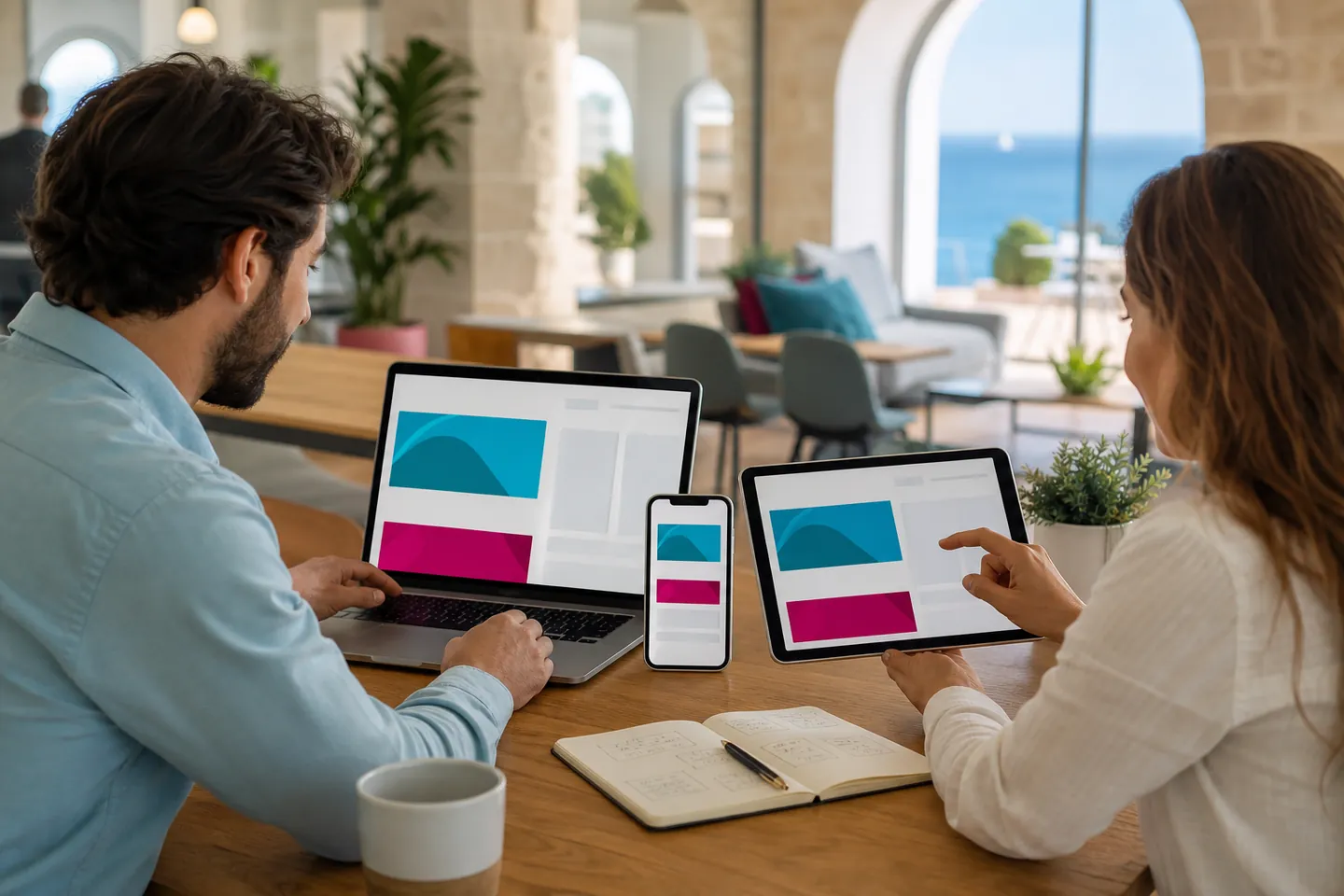
Responsive design is not merely shrinking desktop content. On a phone, headings must remain readable, menus must be easy to operate and important actions must be comfortable to tap. Forms should request only what is necessary. Large images should be compressed so they do not hold up the page on a mobile connection.
Test the entire journey on a real device: arrive from a search result or social post, understand the offer, open the menu, view proof and complete the main action. If any step is awkward, visitors will feel it even if they cannot name the problem.
3. One meaningful conversion path
Decide what a good early conversion looks like. For one startup it may be a demo request; for another, joining a waitlist, booking a consultation or starting a trial. Give that action a specific label. “Book a 20-minute introduction” is clearer than “Submit”.
Repeat the primary call to action at sensible points, but do not make every link compete for attention. Secondary actions—such as reading a case study or viewing pricing—should support the same decision.
4. Credibility that does not rely on big-company claims
New businesses may not yet have a wall of client logos. They can still build confidence honestly. Introduce the founders and their relevant experience. Show the process, a working product view, a pilot result or a detailed example. Explain data handling, payment terms and what happens after a visitor makes contact.
Use specific proof rather than broad superlatives. A short explanation of how you reduced a manual task from two hours to twenty minutes is more persuasive than calling the product “revolutionary”. Never invent testimonials or imply partnerships that do not exist; early trust is too valuable to risk.
5. Secure, dependable lead capture
An enquiry form often handles a startup’s first valuable opportunities. It should validate information on the server, resist automated spam, limit abusive requests and send messages through an authenticated mail service. The sender address should belong to your domain, with the visitor address placed in Reply-To. This improves security and delivery.
Collect only the information needed to respond. Tell the visitor what will happen next and provide an alternative such as a phone number where appropriate. Test form delivery after launch and after major hosting or email changes; a beautiful form is useless if messages disappear.
6. Search-friendly pages with local context
Your company name is not the only phrase potential customers use. Build dedicated pages around the problems and services you actually want to be found for. Use descriptive titles, logical headings, clean URLs, useful page copy and accurate contact information.
Local context should be natural. If you serve customers in Malta, explain how the offer fits that market, the areas you cover and any relevant delivery, language or support details. Do not repeat “Malta” mechanically in every sentence. Search visibility grows from genuinely useful information and a technically sound site.
7. A structure that can grow
Your first site might have four core pages, but the system should allow new service pages, insights, case studies and campaign landing pages without turning navigation into a mess. Use reusable page components and consistent content styles. Keep analytics, forms and metadata organised from the start.
Growth-ready does not mean building a complex portal before customers ask for it. It means avoiding choices that make the next sensible addition unnecessarily difficult. A good design system gives you speed later while keeping the current experience cohesive.
A sensible first-version checklist
- A clear promise written for the customer, not the pitch deck.
- Fast, accessible pages that work across current phone sizes.
- A specific call to action and a secure, tested response path.
- Honest proof and visible people behind the business.
- Search-ready titles, content hierarchy and clean URLs.
- Privacy information, essential legal details and controlled analytics.
- A reusable structure for the next service, story or campaign.
A startup website is a working business asset, not a launch-day poster. Start with the smallest version that communicates clearly and captures a real opportunity. Then improve it using customer questions, sales conversations and measured behaviour rather than guesswork.
Your next step
Need a website that works as hard as your business?
We design clear, fast and responsive websites for businesses in Malta. Tell us what you are planning and we’ll reply with practical guidance.
Get a free consultation