
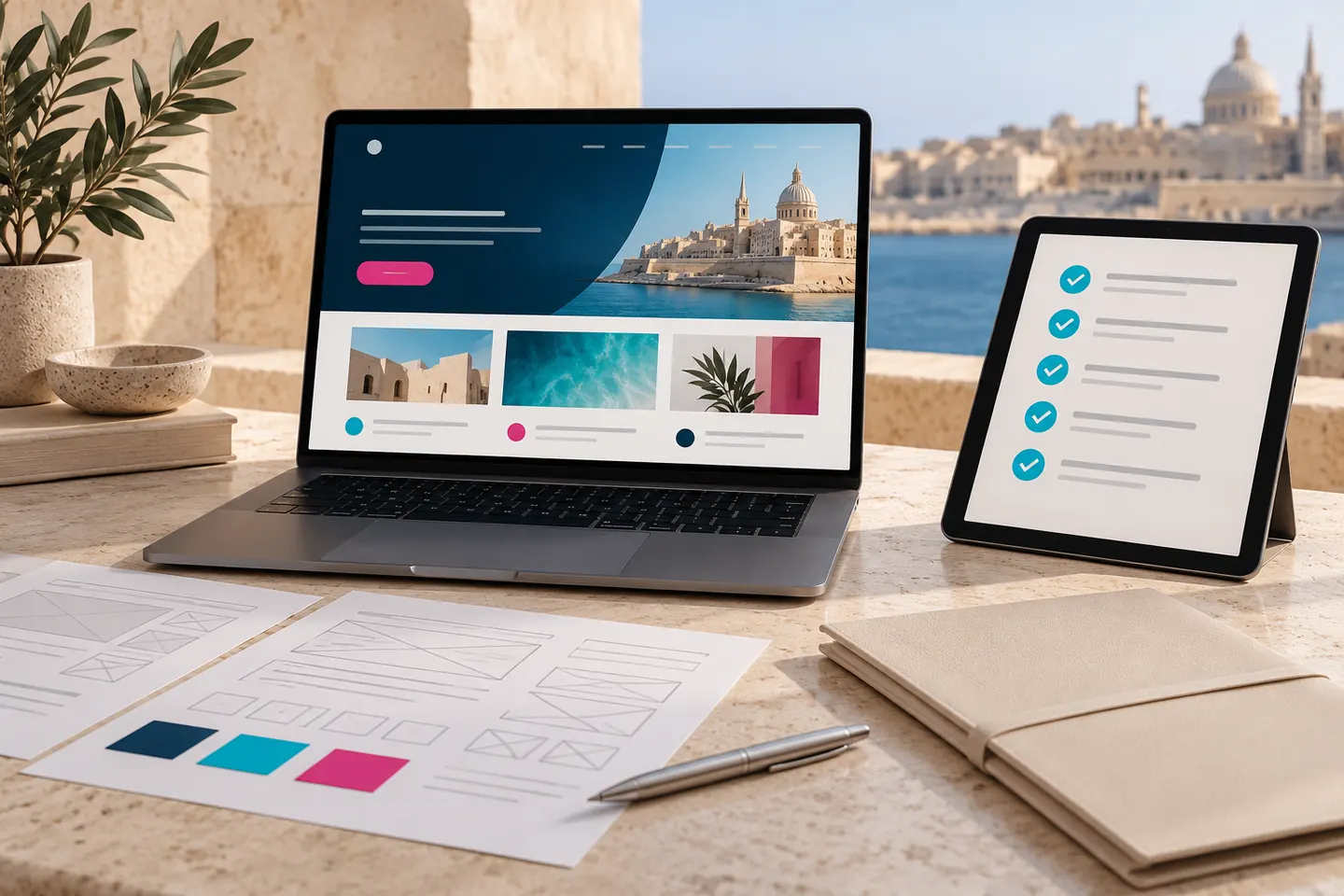
A good-looking proposal does not tell you who will write the pages, whether the form reaches your inbox or what happens when you need a change six months later. Those details belong in the conversation before the deposit.
These questions are for Malta business owners comparing a freelancer, small studio or agency. They are a practical buying checklist, not a certification scheme. A larger supplier is not automatically better, and a cheaper quote is not automatically poor work.
1. What should this website help my business achieve?
A useful answer begins with your customers. A restaurant may need readable menus and reliable bookings. A trade business may need clearer service coverage and enquiries. A retailer needs a buying journey that works beyond the homepage.
Ask the designer to name the primary action and explain the proposed page structure around it. “Modern and professional” is a visual intention, not a full project objective. Agree what you will review at launch: for example, a complete product enquiry journey rather than an undefined promise of more sales.
2. What is included, excluded and waiting for my input?
Request a written list covering pages, features, content, image sourcing, revisions, integrations, launch and handover. Ask who writes the text, who checks business facts and who enters the initial products or articles.
For multilingual work, specify the languages, translation responsibility and which pages are included. A language-switch button does not mean every product, form response and legal page has been translated. For Malta and Gozo coverage, discuss the actual information customers need instead of buying dozens of near-identical locality pages.
3. Can you show live work and explain your role?
Open portfolio examples on your own phone. Check whether the navigation works, the text is readable and important actions are easy to find. Ask which parts the supplier designed or developed, when the work was completed and whether the live site has changed since handover.
Concept artwork can demonstrate a visual direction, but it should be labelled as a concept. A screenshot is not proof of client results. If a supplier claims an improvement in enquiries, ask how it was measured, over what period and what else changed.
4. Who controls the domain, hosting and accounts?
Ask whose account holds each service, who can recover access and what you receive at handover. Separate domain registration, hosting, the website code, licensed software and commissioned content: they are different things.
ICANN explains that the registrant holds the rights to a registered domain name. Confirm the appropriate registration arrangements with your registrar, particularly for the extension you choose. Keep business-controlled recovery details and agree how a supplier receives access without becoming your only route back in.
5. How will the site work on mobile and with a keyboard?
Request a review of actual pages, including the form, navigation and any booking or checkout system. Testing only the homepage misses the point where customers make a decision.
Try moving through the page with the Tab key. Can you see where the focus is? Are form labels clear, and can you read the page at a larger text size? The W3C’s Easy Checks for web accessibility offer useful first checks, while explaining that these do not constitute a complete accessibility evaluation.
6. What do “SEO included” and “fast website” mean?
Ask for deliverables: appropriate page titles, crawlable content, internal links, canonical URLs and a sitemap where relevant. Clarify whether search research, content writing, local profile work or ongoing reporting are included separately.
Google’s advice on choosing an SEO provider warns against guaranteed first-place rankings. Ask for evidence and clear explanations instead. Likewise, request the URL, device mode and date of a performance test; a score for a supplier’s demo does not establish your finished site’s results.
7. How will enquiries, bookings or payments be tested?
Agree a test that reaches the operational result. For enquiries, that includes a valid submission, rejection of invalid information, an understandable error path and a message arriving at the authorised destination. For a shop, agree appropriate payment test-mode checks and order handling.
Ask who supplies email or payment credentials, which services charge separately and who monitors problems after launch. A green success message is not evidence that somebody read the email.
8. Who keeps the website and its software up to date?
Discuss maintenance in terms of tasks: software updates where applicable, backups, recovery testing, account access and content changes. Different platforms have different needs, so the answer should reflect the proposed build.
Ask how much editing you can do yourself, which changes need a developer and what a support request normally involves. Specify any included hours, response arrangements and exclusions. Do not treat “ongoing support” as an unlimited service unless the agreement says so.
9. What is the full cost beyond launch?
List setup, recurring services, renewals, paid licences, maintenance and optional work separately. Compare prices on the same VAT basis and over the same period. If you are considering a subscription, read our monthly versus upfront comparison.
Also ask what changes the price: extra products, revisions beyond the allowance, a different integration or delayed content. A clear change process protects both parties from an open-ended project.
10. What happens if the project pauses or I leave?
Ask about milestones, approvals, cancellation, exports and handover before there is a disagreement. Clarify what happens to the domain, email, content and any paid service if the working relationship ends. Obtain professional advice on contract terms you do not understand.
A workable exit plan is not a prediction of failure. It makes responsibilities easier to understand while everyone is still on good terms.
A short brief you can send to every supplier
- What the business does and whom it serves.
- The main action the website should support.
- Required pages, languages and integrations.
- Content and images already available, including usage rights.
- Your intended launch window and any genuine dependencies.
- The budget range you are comfortable discussing.
- Your expectations for editing, ownership and support.
Two common questions before choosing
Should I hire an agency or a freelancer?
Choose the arrangement that can deliver and support your agreed scope. Ask who does the work and who covers absences or specialist needs. The label alone does not answer those questions.
Should I choose the cheapest quote?
Only after comparing what it includes and what you must supply or pay for separately. Use our website cost guide to turn competing quotes into a like-for-like decision.
Bring the same brief to Kollox and we can explain which website package is a sensible starting point, with the scope agreed before work begins.
Your next step
Need a website that works as hard as your business?
We design clear, fast and responsive websites for businesses in Malta. Tell us what you are planning and we’ll reply with practical guidance.
Get a free consultation